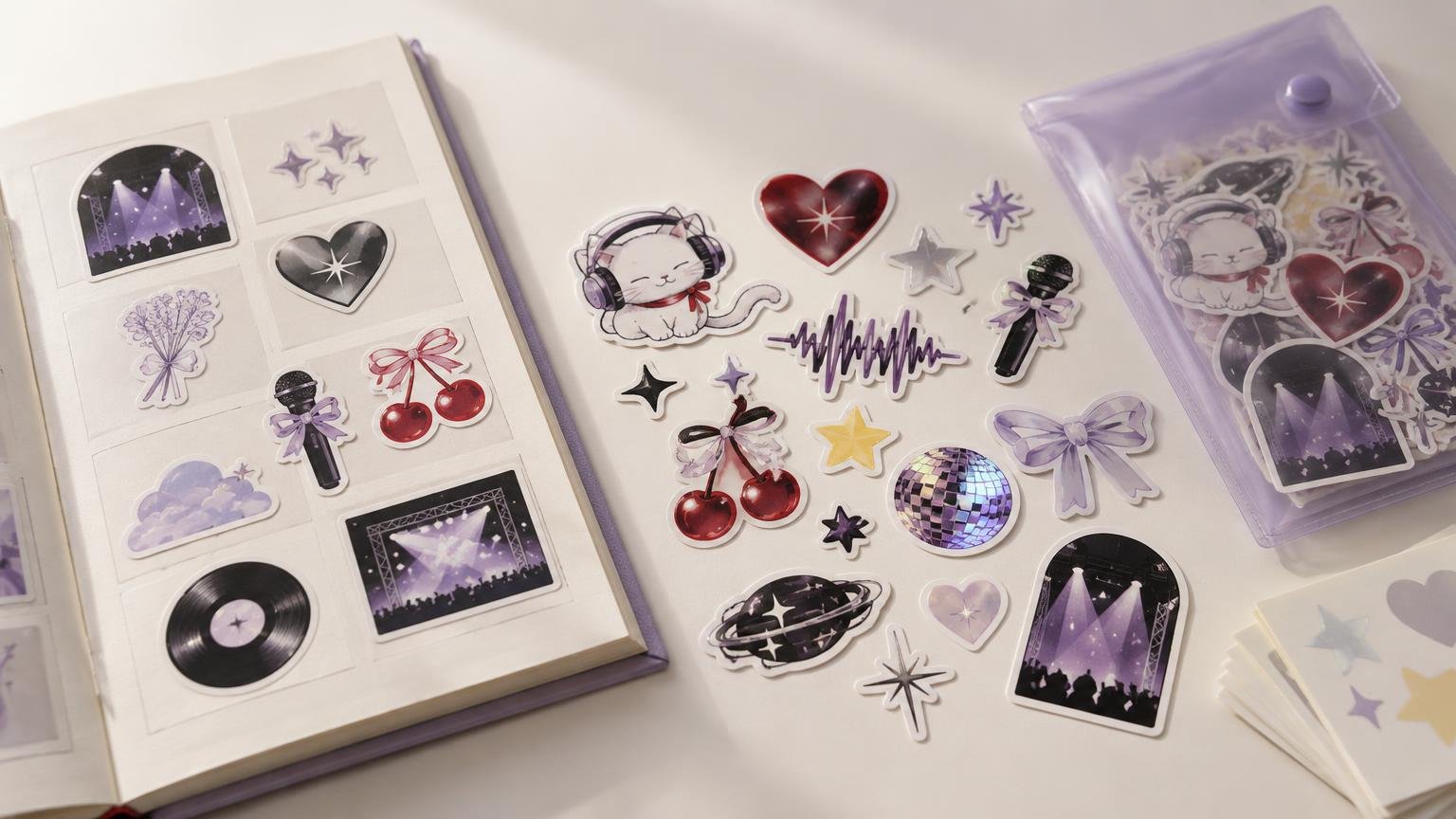
K-Pop Stickers: How to Build a Cohesive Themed Collection
TLDR
The best K-pop sticker collections begin with one clear rule: a group, era, member-inspired palette, character line, concert memory, or visual style. Divide your stickers into pieces to preserve and pieces to use, then choose storage that matches that decision. Cohesion comes from repeating a few visual elements—not from owning every available design.
K-pop sticker collections can quickly become a colorful pile of logos, portraits, characters, album references, freebies, and fan art. That variety is part of the fun, but it can also make a collection feel accidental. The solution is not necessarily a larger binder. It is a tighter point of view.
Think of your stickers as a small visual archive. A satisfying collection records the colors, eras, graphics, and memories that matter to you. It does not need to document an entire group’s career or contain every member variation ever released.
Choose one rule for your K-pop sticker collection
Start with a sentence that defines what belongs. If a new sticker does not fit that sentence, it can go on a separate wish list rather than entering the collection automatically. This is the same principle behind collecting artist stickers with intention: the boundary creates the collection.
Useful collection rules include:
- One group across several eras, with a separate section for each comeback or album cycle
- One favorite era, limited to its palette, styling, symbols, and typography
- A member-inspired collection based on recurring colors, animals, objects, or stage imagery
- An official character line or mascot family
- Concert memories, including tour graphics and stickers connected to shows you attended
- A visual style such as cute illustration, monochrome graphics, retro typography, pixel art, or maximalist collage
- A color-led collection that combines several groups while maintaining one tightly controlled palette
Collecting by group offers the most flexibility, but it can also become too broad. Collecting by era creates stronger visual continuity because album campaigns often have recognizable palettes and motifs. A style-based collection gives you more room to include independent artists, provided the work is clearly credited and its source is understood.
If you cannot choose, begin with a temporary rule for your first 20 pieces. After arranging them, notice what repeats naturally. You may discover that you care less about completing a member set and more about silver typography, cartoon mascots, or candy-colored graphics. That is useful information, not a collecting failure.
Separate stickers to save from stickers to use
The eternal sticker question is whether to peel or preserve. There is no universal answer, so make two categories before organizing anything.
The save group
Keep a sticker unused when its original sheet, packaging, provenance, or personal meaning matters to you. Album inclusions, event mementos, and harder-to-replace pieces may belong here. Leaving a sticker on its backing also preserves your future options, although it does not guarantee financial value or rarity.
The use group
Put duplicates, replaceable designs, and stickers purchased specifically for decoration into a use group. Give these pieces a destination: a journal, reusable sticker book, removable display insert, phone-case insert, or dedicated collage page. Avoid sticking them directly to albums, photocards, signed items, or valuable packaging unless you are comfortable making a permanent change.
This split removes the guilt from using stickers. You are not making one dramatic decision about the entire collection; you are assigning each piece a role.
Pick a format that matches your collecting goal
| Format | Best for | Main tradeoff |
|---|---|---|
| Sticker book | Rearranging and browsing usable stickers | Adhesive performance can vary, so test an unimportant sticker first |
| Binder or storage folder | Keeping backed stickers organized by group or era | More archival than decorative |
| Journal spread | Connecting stickers with notes, lyrics, tickets, or memories | Pages are fixed once completed |
| Collage page | Building one concentrated visual composition | Overcrowding can hide individual designs |
| Display board or framed insert | Showing a rotating selection without altering other collectibles | Light and handling may affect displayed pieces over time |
| Everyday surface | Enjoying replaceable stickers on cases or notebooks | Wear is part of the deal |
A binder works well for a collection that behaves like an archive. A journal works better when the story matters as much as the objects. For example, a concert spread might combine a tour-themed sticker, the date, a handwritten memory, and colors sampled from the show graphics. It becomes a record rather than a merchandise checklist.
You can also use a hybrid system: preserve official or sentimental pieces in a binder and build rotating pages from independent art, duplicates, and decorative designs. Label sections by era, palette, or source so future additions have an obvious home.
Make different stickers look like one collection
Cohesion does not require every sticker to match. It requires repetition. Choose one or two visual rules and let everything else vary.
- Palette: Repeat two dominant colors plus one accent color.
- Scale: Mix one large focal sticker with several medium and small supporting pieces.
- Style: Keep photography, cute character art, hand lettering, or graphic symbols together when a page feels too busy.
- Shape: Repeat stars, hearts, circles, speech bubbles, or strong die-cut silhouettes.
- Finish: Group reflective or holographic pieces rather than scattering visual effects everywhere.
- Typography: Use lettering as a repeated structural element, not as filler for every empty space.
- Negative space: Leave visible gaps so each piece retains its silhouette.
A useful page rhythm is one focal piece, two or three supporting designs, and a few small accents. Five equally loud portraits or logos will compete for attention. One portrait surrounded by smaller symbols, lettering, and color echoes gives the eye somewhere to land.
Visual style matters at sticker scale. Thick outlines, distinct silhouettes, controlled palettes, and readable lettering often remain recognizable more easily than low-contrast detail. The broader guide to sticker art styles can help you name the visual language you are already drawn to.
Understand what you are collecting
“K-pop sticker” describes a subject, not a single merchandise category. A physical sticker might be official merchandise issued through an artist or label’s authorized channel, a licensed product made with permission, an independently illustrated fan work, a promotional freebie, or an unauthorized reproduction. Appearance alone cannot prove which category it belongs to.
Official stickers do exist as a K-pop merchandise format; for example, Weverse Shop has listed an official BTS sticker set. That example does not mean every artist or release offers stickers, and current availability should always be checked through the relevant official channel.
Broader research into K-pop fandom describes physical merchandise collecting and extensive buying, selling, and trading networks, particularly around photocards. That context helps explain why organizing provenance and personal meaning can matter, but photocard market behavior should not be assumed to apply directly to stickers. Readers interested in that wider context can consult the 2025 study of K-pop fandom and platformization.
When buying independent work, look for an identifiable artist, a clear product description, and original illustration rather than a mystery listing built from copied promotional photos. Official and fan-made pieces can share a collection if that mix reflects your goal. Just label them accurately instead of treating “looks official” as evidence.
Keep the collection manageable
Create three short lists: owned, wanted, and passed. The passed list is surprisingly useful because it records designs you considered but deliberately skipped. It turns restraint into part of the collection plan.
A duplicates envelope or binder pocket also prevents extras from floating around. Duplicates can become journal material, gifts, or trades when the source and condition are represented honestly. Set a physical boundary—a binder, box, or fixed number of pages—if clutter is the main concern. When it fills, reorganize before expanding.
Use a simple test before adding a sticker:
- Does it fit the collection rule?
- Does it add a new image, shape, memory, or visual role?
- Do I know whether it is official, licensed, independent, or of uncertain origin?
- Do I already own something nearly identical?
- Can I name where it will be stored or displayed?
If the only answer is “it was available,” leave it on the wish list for a week. Availability is not a theme.
Be thoughtful with fan-made and custom designs
Fan creativity is a major part of the visual energy around music fandom, but admiration does not automatically create permission to reproduce someone else’s photography, illustration, logo, character, or album artwork. The U.S. Copyright Office explains that fair use is evaluated case by case rather than through a fixed formula. Its fair use overview is a useful starting point, not a ruling on any particular sticker.
For a personal project, fan event, or gift, the safest creative route is to develop original artwork from a broad prompt: a concert-night palette, an abstract light-stick-inspired shape, an original mascot, or lettering you created yourself. Avoid tracing official photos, copying album graphics, lifting another fan artist’s work, or assuming that a small quantity removes the rights question. The guide to creating original themed stickers without copying artwork offers a practical art-first process.
Once you have original or appropriately licensed artwork, production becomes a separate practical task. Resources covering custom sticker formats and artwork preparation can help you think through shape, size, and format. CustomStickers.com also states that customers can upload artwork and select sticker type, shape, size, and quantity. Neither route changes the need to have the right to use the artwork.
Build a collection that remembers something
A cohesive K-pop sticker collection is not the one with the highest piece count. It is the one whose organizing idea remains visible when you open the binder, turn the journal page, or look at the display.
Choose one rule, establish a save-and-use split, and arrange your first small set before shopping for more. If the page already communicates an era, mood, visual style, or memory, the collection is doing its job. Completionism can keep chasing the next listing; your collection gets to have an ending—or at least a well-designed pause.