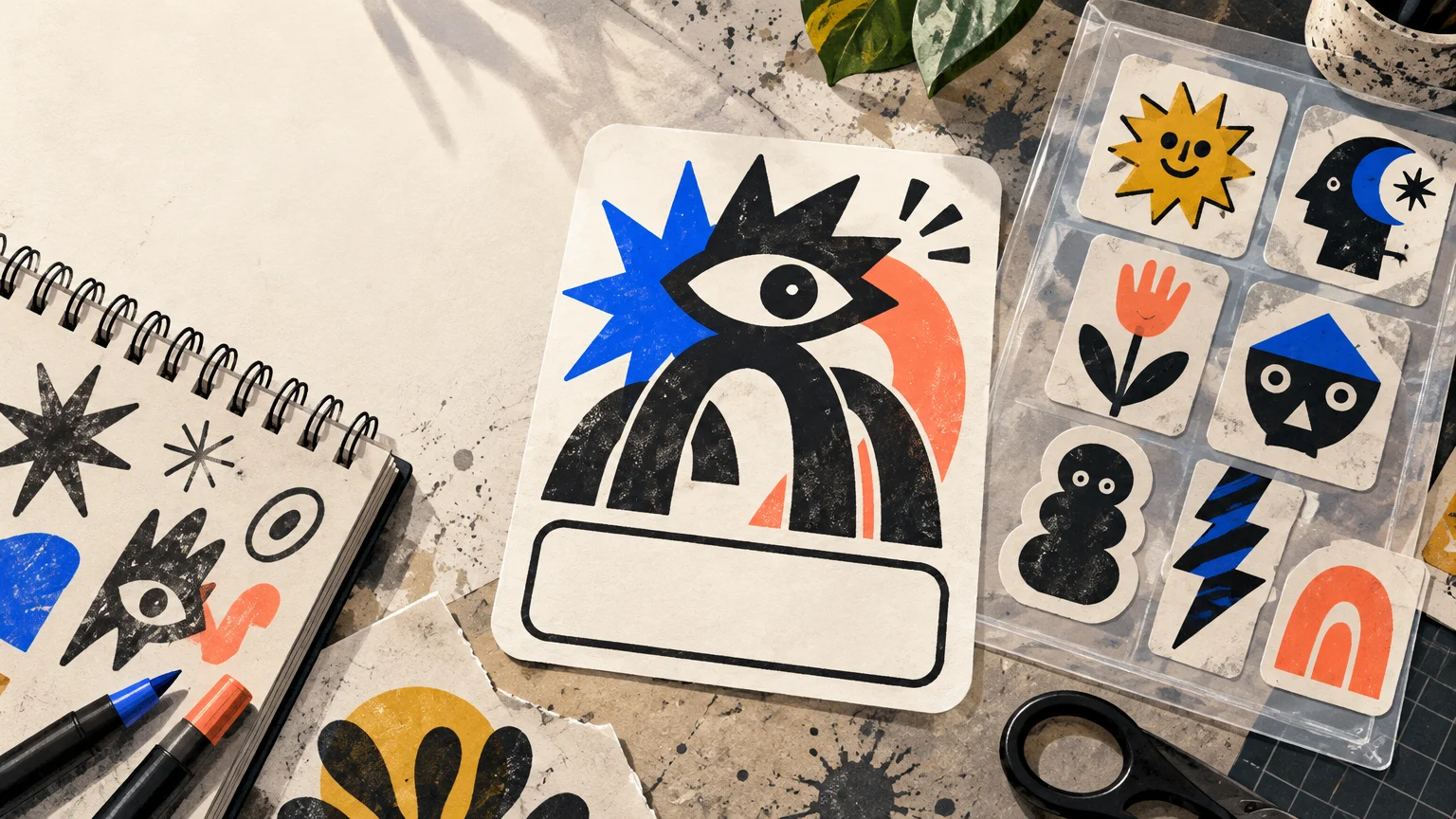
What Does “Slap” Mean in Sticker Art? A Culture and Terminology Guide
TLDR: In sticker-art and graffiti-adjacent language, a “slap” usually means an artist- or writer-made sticker, or the act of applying one. If you searched sticker slaps meaning, the essential point is that the vocabulary is flexible: a slap might carry a hand-drawn name, tag, character, symbol, or compact message, while “slapping” can describe placing it. Not every artist, collector, or local scene uses these terms in exactly the same way.
Sticker slaps occupy a lively middle ground between drawing, graphic identity, public communication, and collectible art. Their physical scale may be modest, but that constraint rewards quick recognition. One bold character, unusual letterform, or recurring symbol can become a compact signature that makes sense on a sketchbook page, in a traded pack, or in an authorized public-art setting.
What are sticker slaps?
A sticker slap is generally a sticker carrying original art, a writer’s name, a tag, a recurring character, a symbol, or a short statement. The phrase is especially common around sticker art, graffiti, and street-art culture, although its boundaries are not rigid. Some people reserve “slap” for hand-drawn or writer-oriented stickers. Others apply it broadly to artist-made stickers associated with those scenes.
Research on sticker artists describes these works as small adhesive pieces that may contain a character, symbol, nickname, or tag, with the artwork typically created before the sticker enters public space. That pre-made quality distinguishes a sticker from a mark drawn directly onto a surface, even when the two carry the same name or visual identity. Research on sticker artists and public space also connects sticker practices with encounters, communication, exchange, and collecting, although its specific fieldwork concerns St. Petersburg rather than every sticker scene.
It is therefore better to treat “slap” as scene vocabulary than as a strict product category. Shape, material, and printing method do not settle the definition. Context, imagery, authorship, and how participants use the word matter more.
Why are they called slaps?
The everyday explanation is practical: a sticker can be slapped onto a surface in one quick motion. From there, the verb also became a noun in common scene usage. Someone might call an individual sticker “a slap,” discuss a pack of slaps, or use “slapping” for the act of putting stickers up.
That explanation should not be inflated into a tidy origin story. The supplied historical evidence does not establish one inventor, first use, or universally accepted date for the term. Informal culture rarely waits for a committee to standardize its vocabulary. Meanings also shift between cities, artist circles, graffiti writers, traders, and collectors.
Small format, recognizable marks
A slap often has very little time or space in which to register. That makes compression part of its visual language. The strongest examples do not necessarily contain the most detail; they contain the clearest hierarchy.
- Tags and handstyles: A name or alias becomes the central image through rhythm, letter structure, outline, and repetition.
- Recurring characters: A face, creature, mascot, or simplified figure can remain recognizable across different colors and poses.
- Symbols and icons: A distinctive eye, hand, object, geometric mark, or emblem can operate almost like visual shorthand.
- Short messages: A compact phrase can be humorous, political, personal, cryptic, or purely typographic.
- High-contrast graphics: Black-and-white art, limited palettes, thick contours, and open negative space often remain readable at small scale.
- Deliberate roughness: Marker texture, uneven lines, photocopied surfaces, and visible corrections can be aesthetic choices rather than defects. Intent should not be assumed without an artist’s statement, but the qualities themselves can be observed.
Repetition matters here. When the same name, character, or symbol appears in several variations, the differences become easier to notice: a wider grin, a harsher handstyle, a new color pairing, or a shift from loose marker lines to crisp digital shapes. Readers interested in these wider visual families can compare the approaches in this guide to sticker-art styles.
Sticker slaps, sticker art, tags, and sticker bombing
These terms overlap, but they point to different aspects of the work. None functions as a universally enforced category.
| Term | Useful working meaning | What it emphasizes |
|---|---|---|
| Sticker slap | An artist- or writer-made sticker, or the act of applying one | Scene usage, speed, identity, and repeated marks |
| Sticker art | The broad creative field of artwork made for or presented through stickers | Artistic medium, composition, illustration, and communication |
| Tag | A stylized name, signature, or identifying mark | Writer identity and lettering |
| Sticker bombing | A dense accumulation of stickers on a surface or object | Quantity, layering, juxtaposition, and collective visual impact |
A single piece can fit several descriptions. A handstyle printed on a sticker may be a tag, a slap, and sticker art at the same time. If hundreds of works accumulate together, the resulting field may be described as sticker bombing. Conversely, an illustrated artist sticker can be sticker art without its maker or collector ever calling it a slap.
Nor does every slap carry an explicit political message. Some communicate a name, joke, mood, local reference, or visual experiment. Others do make direct social or political statements. The image and available artist context should guide interpretation; the format alone cannot establish intent.
Why collectors keep slaps unused
Applying a sticker completes one possible life for it, but it also gives up another. An unused artist sticker can remain part of a collection, trade, archive, or carefully assembled pack. Collectors may preserve it because they value the artwork, want to study variations, or prefer keeping a group intact. That does not make them less involved in sticker culture.
A focused collection also reveals patterns that are difficult to see in isolation. Five stickers by one artist might show how a character changes across poses. A typography-led pack can demonstrate how one handstyle behaves in circles, rectangles, and die-cut silhouettes. A mixed-artist exchange may capture affinities among people who share a theme while retaining visibly different marks.
When evaluating a pack, look beyond whether every sticker is individually appealing. Ask whether there is a connecting thread and enough variation to sustain attention. Useful threads include a shared palette, subject, artist, lettering approach, or recurring shape. Variation can come from scale, density, mood, orientation, or the balance between text and image.
New collectors can use a focused approach to collecting artist stickers rather than buying unrelated packs simply to increase the count. If historical context is the main attraction, the broader history of sticker art provides a route from street-oriented work to contemporary designer-sticker culture.
The mailing-label connection
Blank mailing labels became a visible surface within parts of sticker-art culture because they offered a standardized adhesive field that could be drawn on by hand. Martha Cooper’s 2008 book Going Postal: Mailing Label Street Art documents this strand through more than 200 photographs. View the publication record for Going Postal.
The postal product and its creative reuse should not be confused. USPS identifies Label 228 as a self-adhesive Priority Mail address label intended for mailing. Its official purpose is logistical, not artistic. What artists have done with that familiar rectangle belongs to cultural history, but it does not change the label’s stated postal use.
Visually, the format is worth noticing because a pre-existing border, typography, or block of color forces the artist to respond to a field they did not design. Some artwork competes with that structure; other work incorporates, obscures, or reframes it. That tension between template and mark is part of what makes mailing-label pieces recognizable.
Context, permission, and respect
Understanding sticker slaps does not require placing stickers on public or private property without authorization. A collector can study, trade, archive, commission, or display artist stickers. Artists can work in sketchbooks, create packs, participate in approved exhibitions, use permission walls or sanctioned spaces, and collaborate with venues that welcome temporary sticker displays.
Before applying any sticker, the relevant questions are straightforward: Do you own the surface, or do you have clear permission? Does the venue allow stickers? Are there local rules governing the location? Public visibility is not the same thing as public permission, and an apparently empty surface may still belong to someone responsible for maintaining it.
Respect also extends to authorship. Finding an image online does not make it free to print, trade as one’s own, or reproduce in a pack. When a work is tied to a known artist, look for an official portfolio, shop, publisher, or gallery page before making claims about its origin or availability.
How to read a slap as a small artwork
Start with recognition. What reaches you first: the silhouette, lettering, face, color block, or phrase? Then examine the compression. Has the artist reduced an idea to its essential marks, or does the piece depend on details that disappear at arm’s length? Learning what makes art work at sticker scale can sharpen this kind of looking even if you never plan to design a sticker.
Next, compare repetition and variation. One sticker tells you what the image is; several related stickers show you how the artist thinks visually. Notice which features remain constant and which are allowed to mutate. That is often where a slap becomes more interesting than a disposable decal: it acts as one compact entry in a larger visual language.
The useful takeaway
“Slap” is flexible cultural vocabulary, not a technical specification. It can name an artist- or writer-made sticker, refer to applying one, or signal a connection to graffiti-adjacent and street-art practices. Sticker art is the broader field, while tags and sticker bombing describe particular marks or arrangements that may overlap with slaps.
For the best introduction, compare a few stickers through their handstyle, character design, symbols, negative space, and recurring motifs. Keep them unused if collecting matters to you, display them only where permission is clear, and treat the artist’s authorship as part of the object—not an optional footnote.