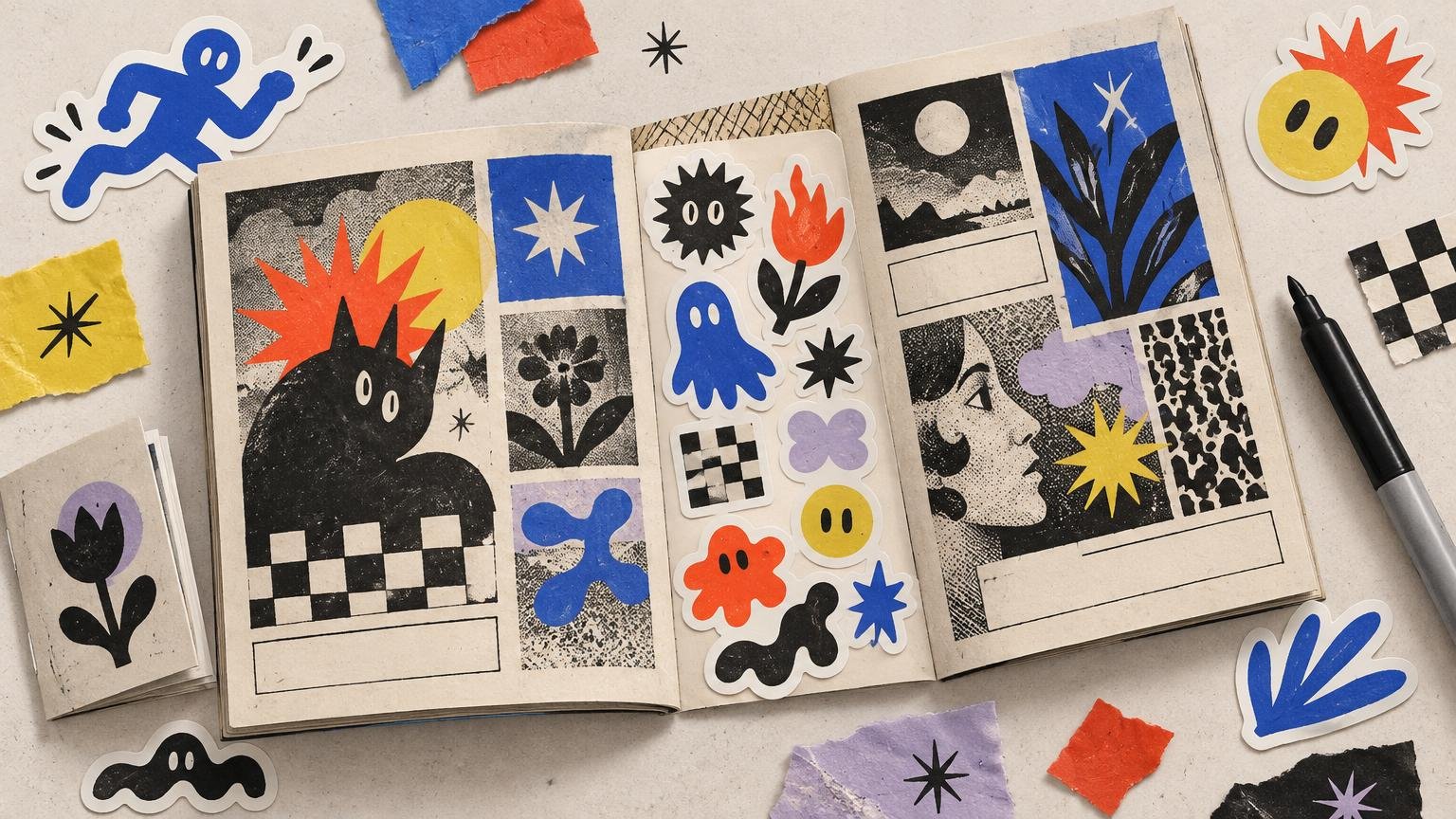
Sticker Art and Zines: Why the Two DIY Formats Keep Overlapping
TLDR: Sticker art zines sit between independent publishing, artist merchandise and visual archives. They may document a sticker scene, include removable sticker sheets, or organize several designs into a deliberate sequence. Their appeal comes from something a loose sticker cannot always provide: context. Pages can preserve artist credits, dates, visual relationships and the editorial voice surrounding the work.
The phrase sticker art zines does not describe one standardized object. It can mean a zine about sticker culture, an artist publication containing stickers, or a pack presented with enough sequencing and commentary to behave like a tiny magazine. What connects these forms is not a particular binding or print specification. It is the decision to treat small graphics as authored work rather than anonymous decoration.
Why sticker art zines feel like natural companions
Stickers and zines share a useful physical directness. Both can carry illustration, collage, typography, photography, repeated characters and political or personal messages without requiring a conventional gallery presentation. Their compact formats also encourage circulation between artists, collectors and readers.
The two formats solve different parts of the same creative problem. A sticker extracts an image from its original setting and turns it into a portable object. A zine restores relationships around that image: what appears before it, what sits beside it, who made it and how it belongs to a larger body of work.
That context matters because sticker art often depends on repetition and recognition. An ethnographic study of sticker artists in St. Petersburg reported that participants could often recognize particular artists through their stickers. The study examines one local community rather than every sticker scene, but it offers a useful example of how recurring images can function as an artist’s visual signature. Readers can explore the study of sticker artists and urban belonging directly.
A zine can show that visual signature developing across pages. One image may establish a character, another may distort it, and a third may reduce it to a symbol or typographic mark. Seen individually, the stickers are separate designs. Seen in sequence, they begin to resemble a visual argument.
Three forms worth distinguishing
Zines that document sticker culture
A documentary sticker zine may collect photographs, artist profiles, interviews, contributor pages or observations about a particular scene. The stickers do not have to be physically removable. The publication’s job is to preserve context that might otherwise be scattered across walls, mail, sketchbooks, trades and temporary displays.
This format can also clarify terminology and local usage. For example, “slap” has flexible meanings within sticker culture; our guide to sticker slaps and collecting language provides a starting point without treating every community’s vocabulary as identical.
Artist zines with sticker inserts
Here, the publication and sticker sheet are designed as related pieces. The pages might expand a character’s world, show alternate compositions, supply a short narrative or reveal how motifs were selected. The insert is not automatically a bonus tacked onto the back. At its best, it acts as a removable extension of the publication.
This creates an interesting collector decision: use the stickers or preserve the complete object. There is no morally superior answer. A reader who applies the stickers is activating the work as intended for movement and display; a collector who keeps the sheet intact is preserving the issue’s original components. The important thing is to describe the copy accurately if it is later traded or sold.
Sticker packs with zine-like structure
A loose pack can become editorial when its contents follow a deliberate rhythm. One large anchor image, several supporting designs, a title card and artist credits can create a beginning, middle and end even without bound pages. This differs from a random assortment whose only organizing principle is that everything fits in the envelope.
The same curation principles discussed in our guide to building and evaluating cohesive sticker packs apply here, but sequence adds another layer. Ask whether removing one piece breaks the visual progression or whether every design still works independently.
How to read a sticker zine as an artwork
Start with the page turn rather than inspecting only the strongest image. A successful publication controls how quickly the eye moves, when dense compositions give way to open space and how often a recurring mark returns. Even a rough photocopied aesthetic can be tightly edited.
- Sequence: Does the order create contrast, escalation, repetition or a loose narrative?
- Scale: Is a small sticker image enlarged to expose texture, or surrounded by space to preserve its compact force?
- Typography: Do captions and credits support the artwork, or compete with it?
- Repetition: Does a recurring character or symbol change meaning across the issue?
- Palette: Is color used as a unifying system, a section marker or a deliberate interruption?
- Material relationship: Does an insert belong visually to the pages, or does it feel like unrelated merchandise?
Small-format graphics must also survive reduction. A design that depends on hairline details or several nearly identical midtones may read well across a zine spread but become muddy as a sticker. Conversely, a blunt silhouette that looks almost too simple on a full page may become the most recognizable piece in the insert. The visual criteria for judging sticker art at small size are useful when comparing those two experiences.
PEEL as a documented example of the overlap
PEEL provides a useful historical case because its own official profile describes it as a sticker, stencil and street-art magazine founded in 2003. That profile also links to compilations covering issues 1–4 and 5–8.
In a 2009 retrospective published by Obey Giant, Dave Combs described PEEL as beginning as a DIY fanzine and developing across eight issues over roughly five years. According to Combs, it moved from a small black-and-white publication to a full-color publication distributed internationally. He also stated that PEEL: The Art of the Sticker collected highlights from the first eight issues. These details are best understood as his account of the magazine’s development rather than independently audited circulation history.
The example shows why the zine format suits sticker culture so well. A publication can gather work that would otherwise be geographically dispersed, place different artists in conversation and preserve an editorial snapshot of a scene. It turns circulation into documentation without making the sticker cease to be a portable image.
What collectors should record
Older artist publications can be difficult to identify when inserts have been removed, covers exist in several variants or a seller uses an informal title. Good cataloging avoids turning guesses into provenance. Record what the object itself supports and label uncertainty plainly.
| Detail | What to record | Why it matters |
|---|---|---|
| Publication identity | Title, issue number, publisher or imprint | Separates an issue from a compilation, reprint or similarly titled project |
| Date information | Printed publication date or a carefully labeled estimate | Prevents an assumed date from becoming accepted history |
| Contributors | Names exactly as credited in the issue | Preserves attribution and helps distinguish collaborations |
| Physical contents | Sticker sheet, loose stickers, cards, wrappers or other inserts | Shows whether the copy appears complete |
| Condition | Writing, folds, adhesive loss, removed stickers or missing pages | Describes the object without vague claims about value |
| Provenance | Receipts, direct artist notes or documented prior ownership | Distinguishes evidence from seller recollection |
If a sticker sheet is partly used, say so. If an insert is mentioned elsewhere but was not present in the copy examined, describe it as absent or unverified rather than declaring the issue incomplete. Edition size, rarity and market value should likewise remain unstated unless publication-level or item-level documentation supports them.
Collectors building around a particular artist, motif or scene may also find the framework in our guide to collecting artist stickers intentionally more useful than accumulating unrelated packs simply because they are available.
Street-art context without flattening the format
Sticker art zines often sit near graffiti, skate, protest and street-art cultures, but that relationship should not be presented as a single universal origin story. In January 2025, KERA reported on North Texas artists who described stickers as portable identifiers and connected them with street, skateboarding and protest culture. That is valuable regional testimony, not a definition that applies to every artist or publication. KERA’s report on North Texas sticker artists provides the fuller context.
The St. Petersburg study also notes that sticker works are generally produced before reaching the street. That distinction helps separate the making, trading, archiving and collecting of sticker art from questions about where someone later places it. A collection or zine can discuss street-facing work without encouraging unauthorized placement. Legal walls, permission-based installations, sketchbooks, display boards and preserved publications all provide other contexts for viewing the art.
Planning an artist zine with a sticker insert
Begin with the editorial relationship, not the manufacturing menu. Decide what the pages contribute that the sticker sheet cannot. They might establish a narrative, document variations, credit collaborators or show the visual research behind a set without reproducing protected source material.
- Choose one organizing thread: artist, subject, character, palette, place or visual technique.
- Sketch the page sequence before deciding which images become removable stickers.
- Select sticker designs that remain legible and recognizable outside the zine.
- Create a contributor and copyright line that stays with the publication.
- Plan how the insert is attached, removed and described so collectors know what constitutes a complete copy.
- Make a simple catalog record containing the title, date, contributors and contents.
Only after those decisions are stable does production become the next task. Artists ready to turn an original insert concept into a physical component can compare options for custom sticker printing, while keeping proofs, quantities and finishing choices subordinate to the publication’s visual idea.
Collect the publication, not just the loose image
The most useful way to approach sticker art zines is to ask what the pages preserve. A loose sticker gives you the image; a thoughtfully edited zine may also give you its neighbors, credits, date, scene and visual rhythm. That extra frame is why the formats continue to overlap.
When examining an issue, look past the loudest design. Check how images recur, how the scale changes and whether the inserts belong to the publication’s larger idea. Then record only what the object and reliable documentation can establish. That combination—close looking and careful cataloging—keeps a small DIY publication from becoming anonymous ephemera.