What Are Designer Stickers and Why Do People Collect Them?
Designer stickers sit in a funny little space between art, collecting, and everyday life. You can buy a print and hang it on a wall. You can buy a shirt and wear it out. But designer stickers do something else. They travel. They land on laptops, sketchbooks, street signs, water bottles, shipping tubes, guitar cases, and whatever else seems fair game that day. That is a big part of the appeal. Designer stickers are small, but they do not feel small.
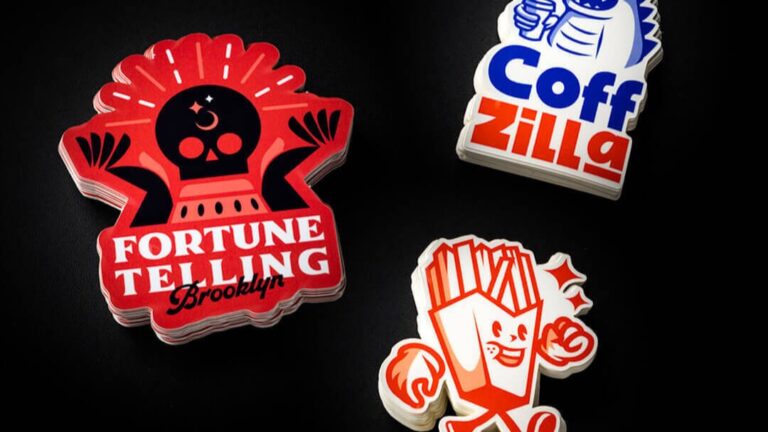
At the simplest level, designer stickers are stickers made with a clear visual point of view. That could mean work from an independent illustrator, a graffiti writer, a graphic designer, a street artist, a printmaker, or a small brand with a distinct voice. The difference is not just that they look cool. The difference is authorship. Somebody made choices. The shapes, colors, linework, lettering, and attitude are there for a reason.
That sounds obvious, but it matters. Plenty of stickers exist only to fill a gap. They are generic, trend-chasing, or built to vanish into a sea of sameness. Designer stickers usually pull in the opposite direction. They feel personal. Even when they are made for a wide audience, they still carry the fingerprints of the artist behind them.
What Makes Designer Stickers Different?
A designer sticker is not automatically fancy, expensive, or trying too hard to be collectible. In my opinion, the real difference is intention. A good designer sticker has a clear identity the second you see it. The silhouette reads. The typography makes sense. The colors feel chosen, not random. And the piece can hold up as a small object without collapsing into visual mush.
That last part is bigger than people think. Stickers are not posters. They do not get much room. If a design works at sticker size, that usually means the artist knew how to edit, simplify, and keep the core idea intact. That is part craft, part restraint, and part refusing to cram five ideas into a two-inch space.
Designer stickers also tend to reward repeat viewing. The first read might be fast. A bold face, a sharp phrase, a weird character, a clean symbol. Then you notice the texture, the edge choices, the balance, or the way the type bends around the image. Good sticker art does that. It gives you the quick hit first, then lets the rest show up later.
Why People Collect Designer Stickers
People collect designer stickers for a bunch of reasons, and not all of them are neat or logical. Some people collect by artist. Some collect by scene, city, or style. Some want packs from shows, drops, and trades. Some just like the feeling of finding a piece that looks nothing like the other stuff out there.
There is also a practical reason stickers work so well as collectible art. They are accessible. You do not need wall space, framing money, or a dedicated room. You can keep them in a box, a binder, or a drawer and still build a collection with real personality. That low barrier matters. It lets people enter the world of art collecting without turning it into a whole production.
And stickers have always had a social side. They get traded, handed out, stuck in public, tucked into orders, passed between artists, and saved from places that vanish later. That makes them feel alive. A sticker can mark a period, a community, a tour, a joke, a mood, or a whole local scene. Sometimes it is just a great image. Sometimes it is a record of where you were and what you were into when you found it.
The Link Between Designer Stickers and Sticker Art
A lot of people meet designer stickers through shopping, but the culture runs deeper than retail. Stickers have a long history in art, activism, design, music, and street culture. Once self-adhesive labels became easier to make and use, stickers moved way beyond pure function. They became a fast way to mark space, spread ideas, signal taste, and circulate visuals outside the normal gallery or advertising system.
That is one reason sticker art still hits. It is fast and portable. You can print a lot of it. You can mail it. You can trade it. You can leave it somewhere and let it start a conversation without you. For artists, that makes stickers a useful format. For collectors, it makes them a record of scenes and voices that do not always get preserved in cleaner, more official channels.
There are archives, museums, and university collections built around this exact idea. That alone tells you sticker culture is not some throwaway side note. People document it because it says something about design history, street language, visual culture, and how art moves through the world when it is not waiting for permission.
What To Look For When Browsing Designer Stickers
If you are new to the category, it helps to know what separates strong work from forgettable work.
Start with clarity. Can you understand the design quickly? That does not mean it has to be simple. It means it has to read. A strong sticker can be dense, strange, or layered, but it still needs a clear entry point. Maybe it is the character, maybe it is the wordmark, maybe it is the shape.
Then look at the point of view. Does this feel like a real artist made it, or does it feel like a trend template coughed it up after a rough weekend? That sounds harsh, but it is usually obvious. The best designer stickers carry a voice. You can sense taste in them. Even if the work is rough, there is something deliberate holding it together.
And think about whether you would still want the piece if it were not attached to a hot trend or a borrowed joke. Strong designer stickers still feel worth keeping once the novelty burns off.
Why Small Format Art Still Works
There is something honest about sticker art. It does not get much room to hide. The piece has to work fast. The material has to hold up. The idea has to survive the scale. That forces decisions, and usually better decisions.
It also makes the format easy to live with. You can actually use it. Or not use it. You can collect it, trade it, archive it, stick it, scan it, frame a few favorites, and keep the rest in a box. That flexibility is part of why people stay into stickers for years.
Designer stickers work because they feel casual and serious at the same time. Casual enough to toss into an order or slap on a case. Serious enough to collect, study, and care about. That is a good lane to be in.
If you are building a site like DesignerStickers.net, that is the heart of the pitch. Good stickers are not just decoration. They are portable design, portable identity, and sometimes portable history.