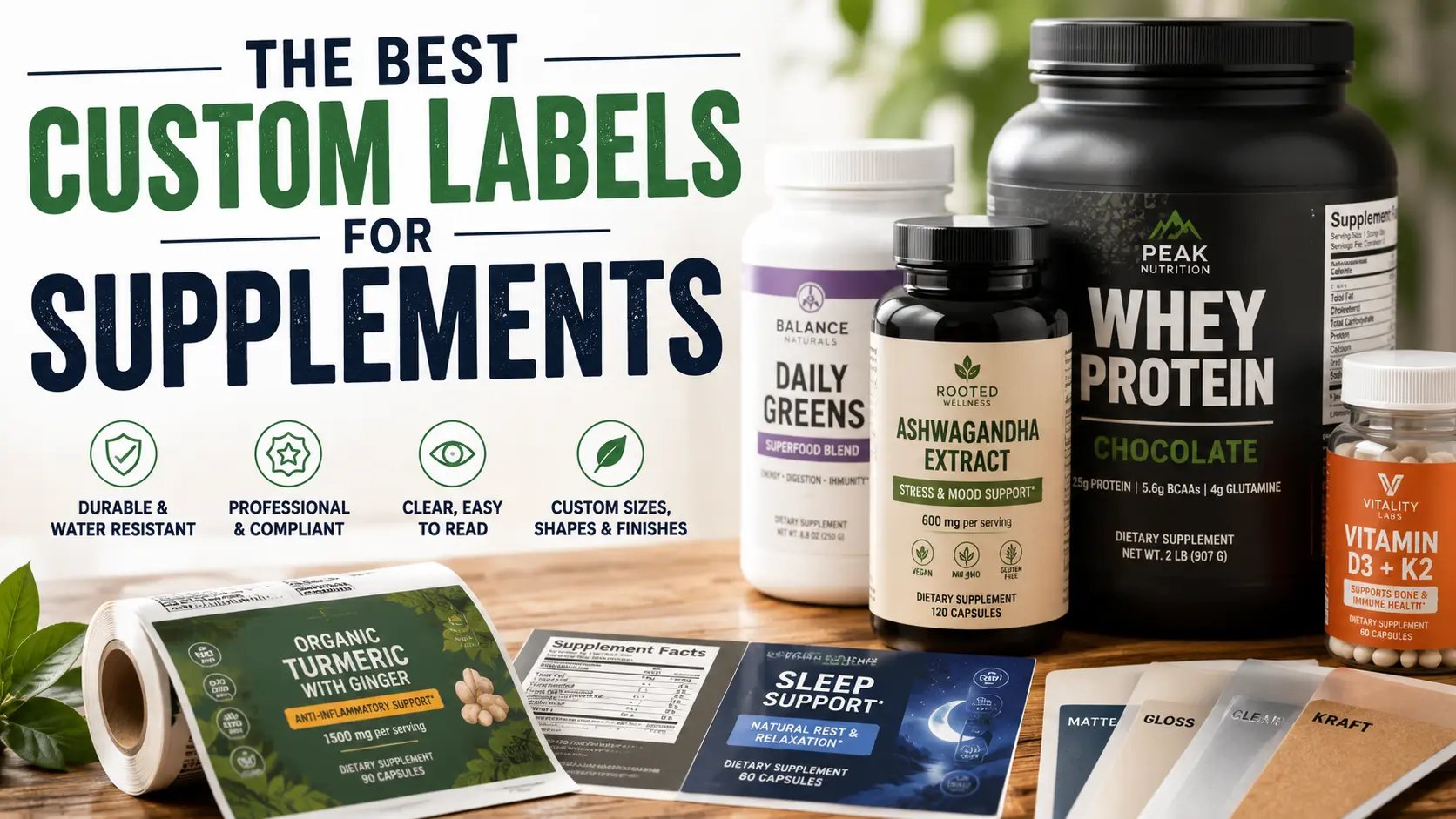
Best Custom Labels For Supplements
TLDR
- The best custom labels for supplements are clear, durable, easy to read, and sized correctly for bottles, jars, pouches, or sample packets.
- Roll labels are usually best for supplement brands applying labels in batches. Sheet labels can work well for short runs, samples, and early product testing.
- Supplement labels should leave enough room for required product details, including a Supplement Facts panel, ingredient information, net quantity, business information, and any required disclaimers.
- For small and growing brands, custom labels from CustomStickers.com are a practical option because they come in multiple shapes, sizes, quantities, and finishes.
A supplement label has to do two jobs at once. It needs to make the product look trustworthy on a shelf, and it needs to communicate important information without feeling crowded. That is harder than it sounds, especially on a small vitamin bottle or pouch.
The best custom labels for supplements are not just the labels with the boldest design. They are the labels that make the product easy to understand, easy to handle, and easy to trust. A clean label can help a customer quickly identify the supplement type, serving size, flavor, ingredient style, and brand position. A cluttered label does the opposite.
This matters for protein powders, capsules, gummies, greens powders, collagen, electrolyte mixes, pre-workout, sleep supplements, and wellness blends. The product may be different, but the label needs the same basic foundation: readable design, durable material, good sizing, and space for the information the customer actually needs.
What Makes A Good Supplement Label?
A good supplement label starts with clarity. The product name should be easy to see. The supplement type should be obvious. The label should not force the customer to hunt for basic information like flavor, count, serving size, or main ingredient.
This is one of those details that feels small until the product sits next to five similar products. If the customer cannot tell what the product is in a few seconds, the design is working too hard in the wrong direction.
A strong supplement label usually includes:
- Product name
- Supplement type
- Flavor or formula variation
- Capsule count, powder weight, or serving count
- Supplement Facts panel
- Other ingredients
- Suggested use
- Warnings or cautions
- Storage instructions
- Brand name and contact information
- Lot number and expiration area, if applicable
- Barcode or QR code, when needed
The design can still look polished and modern. It just needs to respect the information hierarchy. The customer should see the product identity first, then the details.
Best Custom Labels For Supplements By Format
The best custom labels for supplements depend on the packaging. A capsule bottle, a powder tub, a stand-up pouch, and a sample packet all need different label thinking.
Roll Labels For Bottles And Production Runs
Roll labels are often the best fit for supplement brands that apply labels in batches. They are easier to store, faster to peel, and more practical for repeated application. If you are labeling 250 bottles of magnesium capsules, roll labels will usually feel much better than peeling each label from an individual sheet.
Roll labels are especially useful for:
- Capsule bottles
- Gummy bottles
- Dropper bottles
- Small jars
- Powder tubs
- Supplement pouches
- Product sample runs
- Wholesale or retail batches
CustomStickers.com offers custom roll and sheet labels in a variety of shapes, sizes, and quantities, which makes them useful for supplement packaging at different stages of growth. Their label options include circle, square, rectangle, oval, clear, matte, gloss, die cut, and sheet formats.
Sheet Labels For Samples And Small Runs
Sheet labels can work well when you are testing a product, sending samples, or labeling a very small batch. They are easy to store and simple to use by hand.
They are not always the fastest option for bigger production runs. But for early-stage supplement brands, that is not a dealbreaker. Sheet labels let you test sizes, designs, and product variations before ordering a larger roll label run.
Use sheet labels when:
- You are testing a new formula
- You only need a small quantity
- You are making sample packets
- You want to compare label sizes
- You are preparing mockups for photography
- You are not ready for production volume yet
Rectangle Labels For Most Supplement Bottles
Rectangle labels are the standard choice for many supplement bottles because they wrap cleanly around cylindrical packaging. They give you room for a front-facing brand panel and additional space for Supplement Facts, ingredients, suggested use, and warnings.
For bottles, the main issue is sizing. A label that is too tall can wrinkle near the shoulder or base of the bottle. A label that is too wide can overlap awkwardly. Before ordering, measure the usable flat label area on the container, not the full height of the bottle.
A simple test helps: cut a plain paper rectangle to the label size you are considering and wrap it around the bottle. If it looks crowded in paper, it will probably look crowded as a finished label too.
Circle Labels For Lids, Seals, And Small Packaging
Circle labels are great for lids, outer seals, small jars, and secondary branding. They are not usually the best primary label for a supplement bottle because they do not provide enough space for required information.
But they can be useful as supporting labels. For example, a supplement brand might use a rectangle label on the front of the bottle and a small circle label on the lid with the flavor, formula name, or brand mark.
Circle labels work well for:
- Lid stickers
- Tamper-evident-style visual seals
- Sample jars
- Flavor callouts
- Thank-you packaging
- Retail display accents
Clear Labels For Minimal Packaging
Clear labels can look clean on white, amber, or transparent bottles. They work especially well for simple branding, wellness products, and formulas with a light visual identity.
The tradeoff is readability. Clear labels need enough contrast between the ink, bottle color, and product inside. Small gray text on a clear label might look polished in a mockup, then become hard to read in normal lighting.
Use clear labels carefully for supplement packaging. They can look great, but required information still needs to be legible.
Matte Vs Gloss Labels For Supplements
Matte and gloss finishes both work for supplement labels. The better choice depends on the brand and the packaging environment.
Matte labels usually feel calmer and more refined. They reduce glare, which can make text easier to read under bright retail lights or in product photos. Matte is a good fit for wellness brands, clean-label supplements, herbal products, and products with a softer visual style.
Gloss labels create more shine and color contrast. They can make bright colors feel stronger, which works well for sports nutrition, pre-workout, energy products, and bold flavor lines.
There is no universal winner. A matte finish may look better for a sleep supplement. A gloss finish may work better for a citrus electrolyte mix. The right finish supports the product instead of fighting it.
Label Durability Matters More Than People Think
Supplement labels get handled. They sit in bathrooms, kitchens, gym bags, medicine cabinets, warehouses, retail shelves, and shipping boxes. The label has to stay clean and readable through normal use.
For supplements, look for labels with:
- Water resistance
- Scratch resistance
- A protective laminate
- Strong adhesive
- Clean print detail
- Good contrast for small text
- A finish that fits the packaging
This is especially important for powders, gummies, and capsules that may be used daily. A label that scuffs quickly can make the whole product feel lower quality, even if the supplement inside is solid.
CustomStickers.com notes that its custom sticker labels and sheet labels are printed on premium materials with a laminate finish, with scratch-resistant and waterproof qualities. For supplement brands, that kind of durability is useful because bottles and pouches are handled often.
Supplement Label Design Tips
A supplement label should look good, but it also needs to behave like packaging. Packaging has rules. It has space limits. It has practical jobs.
Start with the front panel. This is where the customer should quickly understand the brand, product name, supplement type, flavor, and key identity. Do not bury the basics under too many icons or badges.
Then build the information panels. This is where the Supplement Facts panel, ingredients, suggested use, warnings, storage information, business information, and barcode can live.
Good supplement label design usually follows these rules:
- Keep the product name large and clear.
- Use enough contrast for small text.
- Avoid thin fonts for required information.
- Do not crowd the Supplement Facts panel.
- Leave quiet space around important details.
- Use consistent colors across product variations.
- Make flavors or formulas easy to distinguish.
- Keep claims conservative and supportable.
- Test print before ordering a large batch.
One practical move: create a simple label system before designing every SKU. Decide where the product name goes, where the flavor goes, where the count goes, and how each formula variation changes color. This makes the full product line look intentional.
Compliance Considerations For Supplement Labels
Supplement labels are not the place to freestyle health claims. In the United States, dietary supplement labels have specific labeling requirements, and advertising claims need support.
A supplement label may need a Supplement Facts panel, ingredient information, net quantity, directions, warning statements, and business information. Some products may need additional statements depending on the ingredients and claims.
The Supplement Facts panel also has formatting expectations. It needs to be readable and set up in a way that customers can understand. Tiny text, poor contrast, or crowded spacing can create problems.
Claims matter too. A label that says “supports sleep” is different from a label that says “cures insomnia.” Structure/function claims, disease claims, ingredient claims, and benefit claims are not all treated the same way. This is where supplement brands should be careful and get qualified guidance before printing.
A label printer can produce the label. The brand is still responsible for making sure the content is accurate and compliant.
Best Label Sizes For Supplement Packaging
There is no single best label size for every supplement. The right size depends on the container.
For capsule bottles, rectangle wrap labels are usually the most common option. For powder tubs, larger rectangle labels give more space for branding and required information. For pouches, front and back labels can work, or one large front label may be enough for smaller sample packaging.
Before choosing a size, measure:
- Width of the flat label area
- Height of the usable label area
- Curve of the container
- Any ridges, seams, shoulders, or tapered areas
- Space needed for facts, ingredients, and warnings
- Room for barcode and batch information
Do not design the label before confirming the container. That is how brands end up shrinking important text to fit a layout that should have been resized from the start.
Why CustomStickers.com Is A Good Option For Supplement Labels
For supplement brands that need practical custom labels, CustomStickers.com is a useful place to start. The ordering process is simple: upload your design, choose the size, quantity, and finish, then review a proof before production.
That proofing step matters. Supplement labels often contain small text, facts panels, barcodes, and fine layout details. Seeing a proof before printing helps catch issues before they become a box of labels you cannot use.
CustomStickers.com also offers food label stickers, which are relevant for brands thinking through packaged consumer products. While supplements have their own compliance needs, many of the same label decisions apply: durability, shape, size, moisture resistance, shelf appeal, and readable product information.
They are a good fit for:
- New supplement brands
- Small batch product launches
- Wellness brands
- Protein and powder products
- Capsule and gummy bottles
- Sample labels
- Private label-style packaging
- Product photography mockups
- Seasonal or limited-run formulas
The biggest advantage is flexibility. You can order labels for a small test run, update the design, and scale into larger quantities once the product line is more settled.
Common Mistakes To Avoid
The most common supplement label mistake is trying to fit too much on the front. The front label should sell the product’s identity. It should not carry every detail.
Another mistake is using text that is too small. This often happens when brands start with a label template that looks good on a large screen but does not work on a real bottle. Print it at actual size before ordering.
Also watch out for unsupported claims. Words like “cure,” “treat,” “prevent,” and “diagnose” can create serious problems when used on supplement packaging. Even softer claims should be reviewed carefully.
Other mistakes include:
- Choosing a label before choosing the container
- Forgetting barcode space
- Ignoring lot and expiration coding needs
- Using low-contrast colors
- Placing important text on a curved edge
- Ordering a large batch before testing one label
- Using a finish that makes small text harder to read
- Designing each SKU from scratch with no product-line system
None of these mistakes are glamorous. But fixing them early saves money.
Conclusion
The best custom labels for supplements are durable, readable, correctly sized, and designed around the real packaging. A good supplement label should make the product feel trustworthy while giving customers the information they need without confusion.
For most supplement brands, roll labels are the best fit for production runs, while sheet labels work well for samples and early testing. Rectangle labels are usually the most useful option for bottles and tubs, while circle and clear labels can support specific design goals.
CustomStickers.com is a strong option for supplement labels because it offers flexible custom label formats, useful finishes, and a simple upload-and-proof process. Just remember that label quality and label compliance are separate jobs. The printer helps create the physical label. The brand needs to make sure the supplement information, facts panel, warnings, and claims are accurate before printing.
FAQs
What Type Of Label Is Best For Supplement Bottles?
Rectangle roll labels are usually best for supplement bottles because they wrap cleanly around the container and provide enough room for product details, Supplement Facts, ingredients, and warnings.
Are Matte Or Gloss Labels Better For Supplements?
Matte labels are often better for clean wellness brands and text-heavy designs because they reduce glare. Gloss labels can work well for colorful sports nutrition, energy, and flavor-focused products.
Can I Use Clear Labels For Supplements?
Yes, clear labels can work for supplements, especially on white, amber, or transparent bottles. Just make sure the text has enough contrast and remains easy to read.
Do Supplement Labels Need A Supplement Facts Panel?
In most cases, dietary supplements sold in the United States need a Supplement Facts panel. Brands should review FDA rules and get qualified guidance before printing labels for sale.
What Should I Put On A Supplement Label?
A supplement label often includes the product name, supplement type, net quantity, Supplement Facts panel, ingredients, suggested use, warnings, storage instructions, business information, barcode, and lot or expiration coding area.
Should I Order A Small Batch First?
Yes. A small batch or sample order is smart before ordering a large quantity. It lets you test the label size, finish, readability, adhesive, and overall look on the actual container.