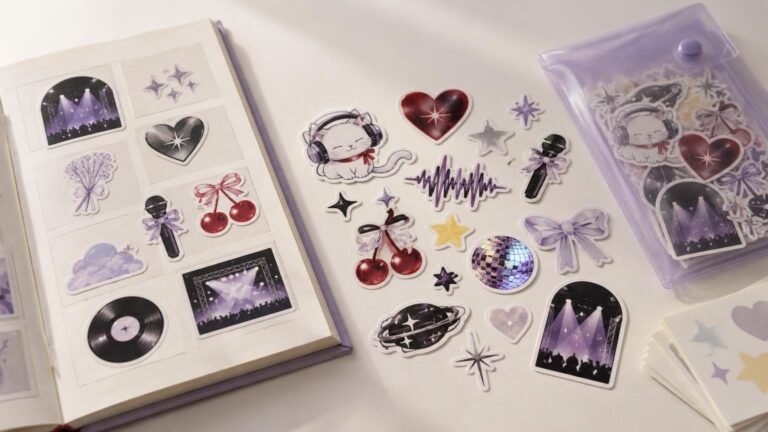
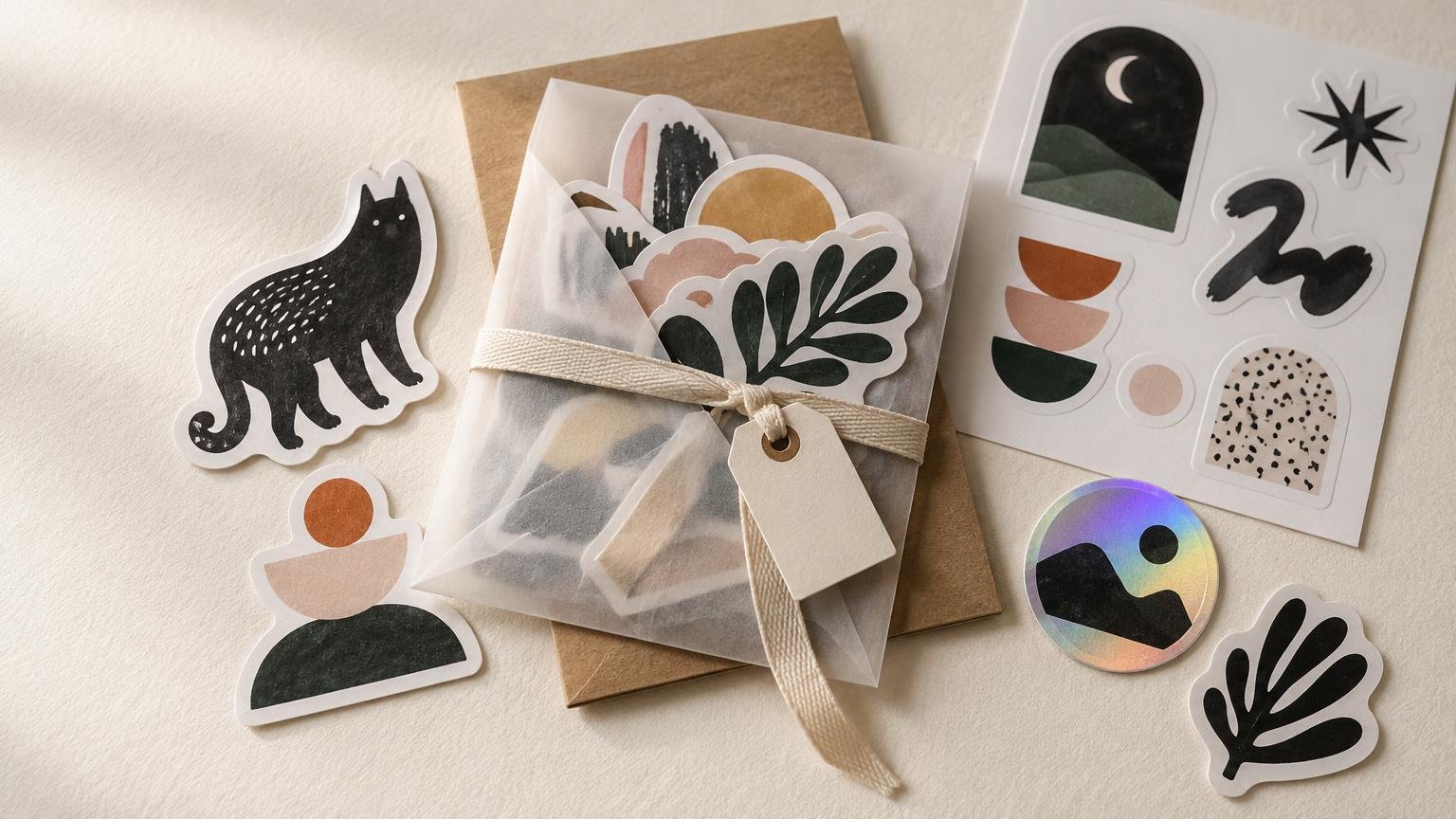
Sticker Packs as Gifts: Theme, Artist Mix, and Presentation
TLDR: The best sticker packs as gifts are chosen like small art editions, not bags of miscellaneous decals. Start with the recipient’s visual taste, decide whether they use or preserve stickers, and then compare artist credit, theme, format, dimensions, packaging, and edition context. A focused five-sticker set from the right artist can feel more personal than a huge assortment with no clear point of view.
Sticker packs as gifts work because they are both objects and possibilities. The recipient can place the art on a sketchbook, trade individual pieces, frame a complete sheet, or keep the pack intact as artist ephemera. They also offer a low-pressure introduction to an illustrator or visual scene: enough work to reveal a recurring language without asking someone to commit wall space to a print.
The difficult part is choosing a pack that feels deliberate. Quantity and shiny finishes are easy to advertise, but neither tells you whether the art suits the person opening the envelope. Begin with their eye, not the sticker count.
What makes sticker packs feel like gifts rather than filler?
A considered pack has a reason for being together. It might present several variations on one character, collect work by a single artist, document an exhibition, or build a visual conversation among multiple contributors. Coherence does not require every sticker to look identical. It means the set has enough shared energy that the recipient can understand why these pieces belong in the same package.
Look at what the recipient already enjoys. A person who fills sketchbooks with heavy black linework may appreciate monochrome character art more than a pastel slogan set. Someone interested in graffiti and street graphics may respond to bold lettering, repeated icons, and slap-like compositions. A collector of zines might value a pack tied to a publication or exhibition because the context matters alongside the individual images. Our guides to sticker art styles and the overlap between sticker art and zines can help narrow the visual direction.
Then consider how they relate to stickers. A user wants pieces that fit the surfaces they actually decorate. A trader may prefer a loose assortment with individually shareable designs. A collector might care more about intact packaging, artist attribution, hand numbering, or accompanying printed matter. None of these approaches is more legitimate; they simply lead to different gifts.
| Recipient type | Look for | Be cautious about |
|---|---|---|
| The active user | Readable designs, practical dimensions, a mix of shapes | Oversized pieces or art whose details disappear at sticker scale |
| The artist fan | A single-artist pack with clear credit and a recognizable visual language | Uncredited assortments that imitate a familiar style |
| The collector | Edition context, intact packaging, numbering, or accompanying print material | Unsupported claims about rarity or future value |
| The trader | Loose stickers, variety, and pieces that work independently | A sheet that must be cut apart or broken up to trade |
| The curious newcomer | A coherent introduction to one artist, scene, or exhibition | A huge random bundle with no useful context |
Choose the visual language before the finish
Finish is an accent, not a substitute for art direction. Holographic, glitter, mirror, clear, and matte treatments can change how a design reads, but the underlying image still needs a strong silhouette, legible type, or clear focal point. If every piece uses a loud reflective effect, the pack can become visually flat in a different way: everything competes at the same volume.
Compare packs using five visual questions:
- Subject: Does the recipient gravitate toward characters, typography, botanical forms, absurd humor, street graphics, or abstract pattern?
- Palette: Will the pack complement their existing collection, or introduce a contrast they would enjoy?
- Line and scale: Do the designs remain readable as small objects, or does the artwork depend on tiny details?
- Repetition: Are variations purposeful, or does the pack feel padded with near-duplicates?
- Range: Can each sticker stand alone while still feeling related to the rest of the set?
For a person with a very specific taste, a single-artist pack is usually the safer choice. A multi-artist pack works better when the recipient enjoys discovery or when a curator, gallery, or exhibition provides a meaningful connection among the contributors. If you are still learning how intentional packs differ from random assortments, see our guide to what makes a vinyl sticker pack worth buying or trading.
Loose packs, kiss-cut sheets, and artist editions
Format changes the experience of the gift. A loose pack contains separate stickers that can be sorted, shared, or placed independently. It often feels abundant and interactive. A kiss-cut sheet holds multiple designs on one backing sheet; the individual stickers peel away, but the untouched sheet can also function as a complete composition. Die-cut stickers are cut around the shape of each design, making the outer contour part of the artwork.
Artist editions and exhibition packs add context rather than guaranteeing quality or monetary value. MOCA Store’s listing for Oliver Payne’s TOGETHER describes a hand-numbered edition of 500 containing a 7-by-7-inch sheet with 57 kiss-cut stickers and a separate print. That combination makes the sheet, numbering, and printed companion part of the work’s presentation, not merely packaging. Readers can examine the MOCA Store edition listing as an example of how a gallery documents format and edition details.
Other releases show how varied the category can be. A24’s Sticker Packs 3.0 page credits five artists and describes packs of 15 vinyl die-cut stickers using mirror, glitter, and holographic finishes. Zoltron’s official store describes the 2024 Zoltron Loves You pack as ten clear- and white-vinyl stickers from a limited run of 500 packs, while noting that contents may vary according to remaining stock. You Are Beautiful’s shop describes its Stick Together full pack as 60 stickers from participating artists connected to the Stick Together exhibition.
These examples are useful as format references, not universal recommendations. Listings, prices, contents, and availability can change. Check the live page before buying, especially when an item has variable contents or is described as an edition.
Collector details matter, but skip the investment hype
Provenance can make a small object more meaningful. Useful details include the credited artist or artists, publisher or gallery, release date, exhibition connection, stated edition size, hand numbering, and any print or card included with the stickers. Keep the original envelope or backing card if it contains that information.
Those details do not prove artistic importance, scarcity on the secondary market, or future resale value. “Limited” is context, not a financial forecast. A hand-numbered pack can still be the wrong gift if the recipient dislikes the artwork, while an open-edition set from a favorite illustrator may become a treasured part of a collection.
Authorization matters more than manufactured rarity. Prefer an artist’s official shop or a clearly identified gallery, museum store, publisher, or collaborator. Confirm that the listing names the artist and explains who produced or released the set. If the seller relies on vague phrases such as “inspired by” while using recognizable characters, logos, or artwork, pause before buying.
What to verify before ordering sticker packs as gifts
Product photographs can hide scale, repetition, and packaging. Read the listing closely and confirm the details that affect the recipient’s experience.
- Contents: Check the number of stickers, number of distinct designs, and whether variations or random substitutions are possible.
- Dimensions: Look for the size of individual stickers or the complete sheet, not only the package dimensions.
- Format: Confirm whether the item is a loose pack, kiss-cut sheet, booklet, roll, or set of separate die cuts.
- Materials and finish: Treat claims such as outdoor-safe, weatherproof, archival, or permanent as item-specific statements that need explicit support from the seller.
- Attribution: Look for named artists and a clear connection between them and the seller, gallery, publisher, or project.
- Edition language: Confirm the stated edition size, numbering method, and whether the edition applies to the complete set or an individual component.
- Packaging: Determine whether a backing card, envelope, print, or protective sleeve is included.
- Timing: Check current stock and delivery estimates, especially when the gift has a fixed date.
When no existing pack quite fits, commissioning an artist or assembling a set from original work can be more personal. Artists preparing their own gift edition can turn finished designs into custom stickers, but the creative decisions should come first: choose a tight theme, remove weak filler, and test whether each image remains recognizable at its intended size.
Present the pack as a small collection
Presentation can turn a thin envelope into a thoughtful object without burying it in elaborate wrapping. Include a short note explaining why the visual language reminded you of the recipient. Mention the artist, exhibition, or idea behind the set when that context is documented. One specific sentence is better than a grand speech about collectibility.
You can also pair the pack with something that supports the recipient’s habits: a plain sketchbook for an active user, mail-art supplies for a trader, or a correctly sized protective sleeve for someone likely to preserve the set. Avoid sticking any piece down on the recipient’s behalf. Choosing the final surface—or choosing not to use the stickers—is part of the pleasure.
For someone starting from scratch, add a simple collecting prompt: keep one artist together, build around one color family, or save examples of a particular character type. That gives the recipient a direction without turning the gift into homework. Our guide to starting an artist sticker collection offers a broader framework for avoiding random accumulation.
Common questions about gifting sticker packs
Is a loose pack better than a kiss-cut sheet?
Choose a loose pack for someone who uses, sorts, or trades individual stickers. Choose a kiss-cut sheet when the complete composition is part of the appeal or the recipient may want to preserve and display it intact.
Should the recipient use the stickers or keep the pack complete?
Let them decide. Some collectors preserve packaging and complete sheets; others regard placement as the final stage of the artwork. If preservation seems likely, keep the pack flat and avoid writing on its original packaging.
Can a sticker pack introduce someone to a new artist?
Yes, particularly when the set shows a recurring character, palette, drawing style, or idea across several pieces. Include the artist’s name and official destination so the recipient can explore more work without guessing who made it.
Choose for the person, not the pile
A successful sticker gift does not need the largest count or the flashiest finish. It needs a point of view that suits the recipient. Decide whether they are a user, trader, artist fan, or collector; choose a visual world they will recognize or enjoy discovering; and verify the format, attribution, contents, and delivery details. The result will feel less like filler and more like what a strong sticker pack can be: a compact, portable encounter with an artist’s work.