How to Sell Stickers Online Effectively: Design, Artwork, and Presentation
TLDR
To learn how to sell stickers online effectively, think like an artist and a curator before thinking like a product catalog. Build a recognizable collection, make every design readable at sticker scale, photograph the actual contents clearly, and offer singles, packs, or sheets for distinct buyer needs. Price from your real costs rather than copying somebody else’s formula, and sell only artwork you created or have appropriate rights to use.
A sticker shop becomes easier to browse when each design leads somewhere: to a character family, visual theme, artist identity, or future release. The goal is not to upload every illustration you have. It is to turn your strongest ideas into a small visual world that shoppers can understand—and may want to revisit.
Start with a collection, not a random product list
A loose assortment can contain individually strong designs and still feel forgettable. A collection gives shoppers a reason to connect one sticker with another. That connection might come from recurring characters, a limited palette, shared lettering, one subject, or a repeated compositional device.
Begin with a one-sentence collection premise. “Odd creatures found in an imaginary corner shop” is more useful than “cute stickers” because it suggests characters, props, signs, packaging, and future additions. If you cannot describe what holds the work together, a shopper will probably struggle to see it too.
Build around one or two hero designs, then add supporting pieces that change the pace. A large character portrait might sit beside a compact object, a short typographic piece, and a quieter emblem. Cohesion does not mean repeating the same drawing with different hats. It means maintaining a recognizable visual logic while varying silhouette, scale, and density.
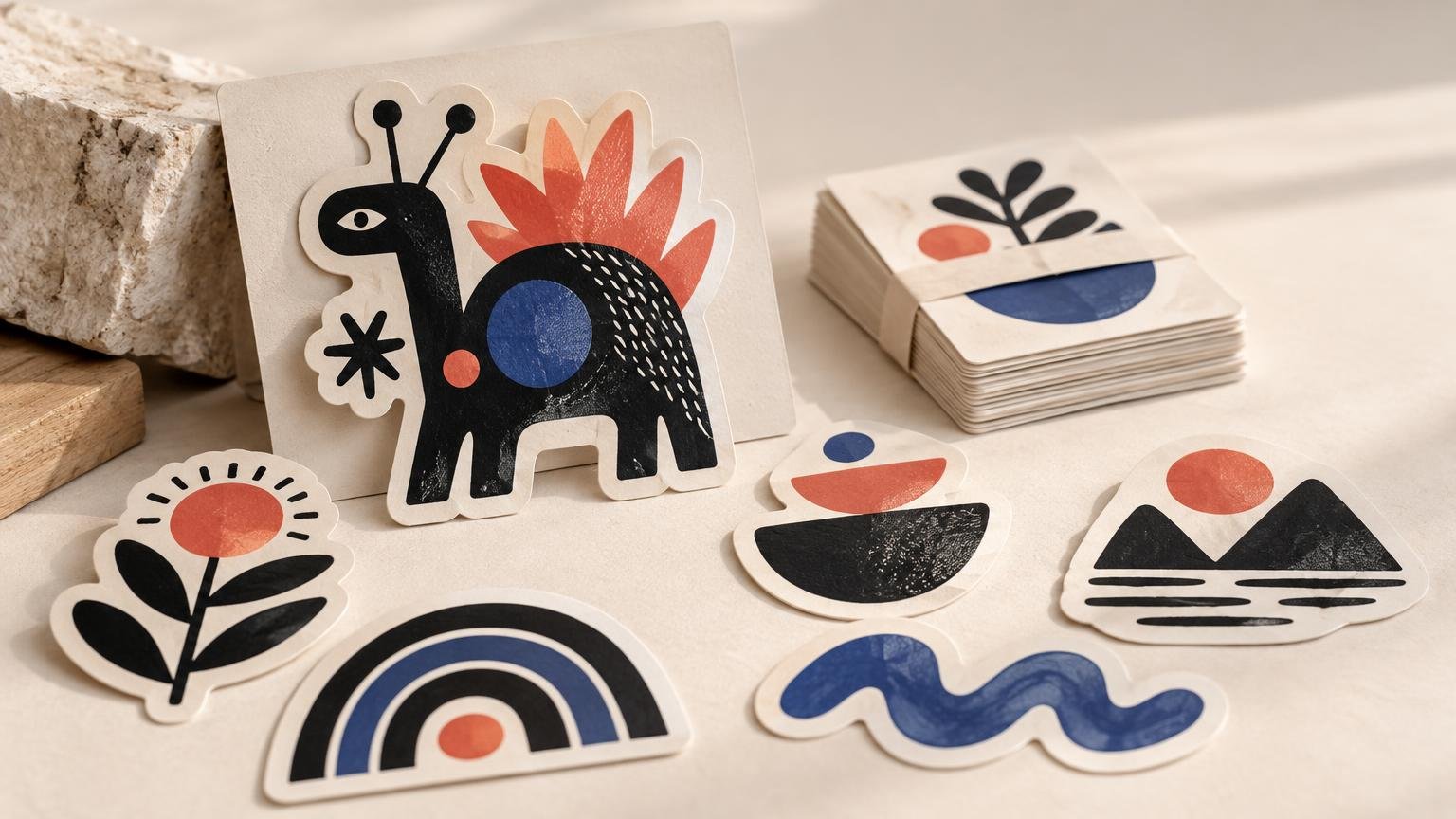
Before expanding a range, decide what each idea wants to be. A bold silhouette can stand alone as a die-cut sticker. Several small related icons may work better together on a sheet. A narrative group can become a pack, while a particularly detailed illustration might belong on a larger print instead. For a deeper collection-building framework, see this guide to what makes a vinyl sticker pack feel curated.
Make your visual identity work at sticker scale
An illustration that looks rich on a monitor can become visual porridge when reduced. View each design at approximately its intended physical size, not only while zoomed in. Check whether the outer shape reads immediately, the focal point remains obvious, and small interior marks still contribute something.
- Strengthen the main silhouette before adding surface detail.
- Separate important shapes with value or color contrast, not only thin outlines.
- Enlarge essential lettering and remove words that cannot remain comfortably legible.
- Use negative space to keep faces, hands, and small objects from merging.
- Choose borders deliberately: they can unify a pack, but an oversized white rim may weaken delicate artwork.
- Test whether each design remains recognizable as a small listing thumbnail.
Consistency also lives outside the drawing. Use a stable naming pattern, clear artist credit, and related presentation across listing images and packaging. You do not need to stamp a giant logo across every piece. A restrained backing card, collection title, or repeated color band can connect releases without competing with the art.
If the theme comes from a familiar genre or cultural reference, develop original motifs rather than tracing or lightly modifying existing work. The process in creating original themed stickers without copying artwork can help turn a broad influence into a collection with its own point of view.
Give singles, packs, and bundles different jobs
Artists do not have to choose between selling individual stickers and packs. The formats can serve different paths through the shop.
| Offer | Best role in the shop | Presentation priority |
|---|---|---|
| Single sticker | A low-commitment introduction to one character or design | Show the exact piece, scale, edge shape, and finish clearly |
| Themed pack | An entry point into a complete visual idea | Show every included design and explain the collection concept |
| Sticker sheet | A coordinated group of smaller graphics | Make individual cut shapes and overall sheet dimensions understandable |
| Bundle | A giftable or repeat-buyer option combining related items | List every component rather than relying on a decorative group photo |
Treat the strongest single as a doorway into the wider collection. Its listing can point to the matching pack, related character, or companion design. The pack page can then explain how the pieces belong together. This creates a useful browsing path without making buyers hunt through unrelated products.
Collectibility can come from continuity rather than artificial scarcity. Recurring characters, numbered collection waves, seasonal chapters, and thoughtful packaging can make a release feel intentional. Do not claim that an item is rare or limited unless the quantity and conditions genuinely support that description.
Photograph stickers as products and art objects
Atmospheric photography creates mood, but it cannot replace clear evidence of what the buyer receives. Etsy’s product-photography guidance recommends cohesive imagery, complementary backgrounds, contextual props, and styling related items together without distracting from the product. That is a useful standard even when you sell through another kind of storefront.
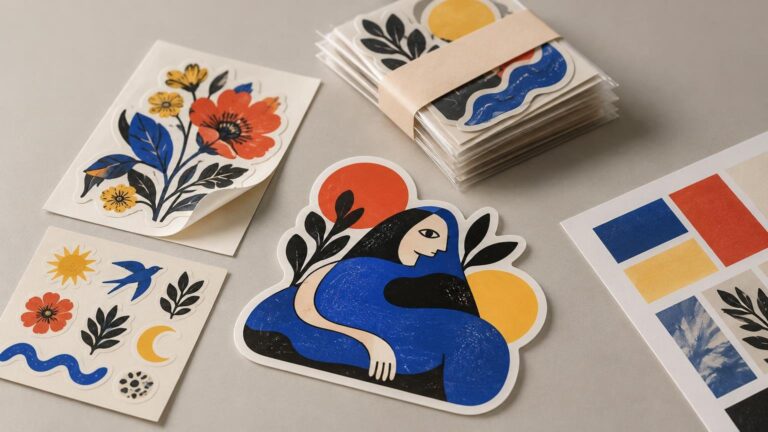
A complete listing image set should answer six questions: What is included? How large is it? What does the surface look like? How does the cut shape behave? How might it look in use? Who made it?
- Lead with a clean hero image showing the full single, sheet, or pack.
- Include an every-design view with nothing hidden under overlapping pieces.
- Provide an honest scale reference using a ruler or a familiar object that does not obscure the art.
- Use an angled detail image when reflection or surface character matters.
- Add an in-context image, while keeping the actual product distinct from styling props.
- Show the backing card, artist credit, or packaging if those are included in the purchase.
Keep color treatment consistent across a collection and avoid edits that make the product appear substantially different from the physical piece. Decorative props should support the visual world, not make buyers play a tiny game of “find the sticker.”
Choose a format that matches the artwork
Format is a merchandising decision as much as a production choice. Die-cut stickers suit designs with distinctive outer shapes and enough visual weight to stand alone. Sheets work well for coordinated icons, small characters, planner-scale graphics, or compositions where the shared background contributes to the presentation. Labels are generally better reserved for packaging, identification, and branding tasks rather than being treated as collectible artwork by default.
Finish should also follow the image. A subdued finish may suit soft color, pencil-like texture, or restrained typography. A reflective surface can intensify saturated color but may introduce glare in photographs and displays. Specialty effects are most convincing when the artwork assigns them a role; applying an effect to every available surface can turn the design into a materials sampler.
Artists comparing die-cut stickers, sticker sheets, and labels can review the vendor’s stated file-review and proofing options before choosing a format. Availability and specifications can vary, so confirm the current configuration when ordering.
Check the artwork before approving production
A proof is a decision point, not a ceremonial screen to click through. Inspect spelling, orientation, crop, cut-line placement, border balance, small gaps, and whether important features sit too close to an edge. Confirm that each item on a sheet is intended to separate in the way shown.
A digital preview can reveal obvious layout errors, but it cannot tell you everything about physical scale or how subtle details will feel in hand. When practical, evaluate a small run or sample before committing more inventory. The related guide to turning artwork into a small-run vinyl sticker pack goes further into preparing and evaluating a first collection.
Build listings that explain the collection
A good listing title identifies the subject and format without becoming a chain of repeated search phrases. Follow it with a compact concept statement: introduce the character, mood, or collection, then move to concrete information.
- Collection and design name
- Artist or studio credit
- Exact number of included pieces
- Dimensions or a clear size range
- Format and finish, when relevant
- What is and is not included in the photographed arrangement
- Packaging details that affect the purchase
- A link or route to related singles, packs, or collections
Write for someone encountering the work for the first time. An inside joke may delight existing followers, but the listing still needs to identify the object. Clear contents also reduce the risk that a styled photograph will be mistaken for a larger bundle.
Price from a cost model, not a generic formula
There is no responsible universal sticker price or margin. Your workable figure depends on production quantity, packaging, sales channel, payment processing, shipping support, labor, replacement risk, and the contribution the business needs from each sale.
Calculate the cost of the sellable unit first. For a pack, include every sticker and the packaging rather than applying the cost of one design. Add per-order expenses, allocate shared expenses using a method you can repeat, and estimate the time required to prepare and fulfill the order. The difference between the selling price and these costs must be enough to sustain restocking and the rest of the business.
Then test the result against the offer. If a pack feels too expensive, the answer is not automatically to slash the price. You might simplify packaging, remove a weak supporting design, reduce costly variations, or reposition the group as separate singles. Likewise, a bundle discount should still leave a deliberate contribution; “more products for less money” is not a strategy if every order creates a loss.
Protect the artwork and the artist identity
In the United States, copyright protects original works of authorship once they are fixed in a tangible form. The U.S. Copyright Office also provides registration guidance for visual art such as illustrations, graphic designs, logos, labels, and prints. Its copyright overview is a useful starting point for artists.
Use artwork you created, artwork covered by a suitable license, or work for which you have appropriate permission. With collaborators, put ownership, permitted products, credit, payment, reprints, and unsold inventory terms in writing before production. Fan art can raise fact-specific copyright and trademark questions; changing a few details or adding a disclaimer does not automatically create permission.
Copyright and trademark address different things. Copyright concerns original creative expression, while a trademark identifies the source of goods or services. Federal trademark registration can provide benefits beyond unregistered use, and the ® symbol is reserved for registered marks. An artist considering registration or facing a rights dispute should seek qualified legal advice rather than relying on general storefront guidance.
Build a path people can follow
The practical answer to how to sell stickers online effectively is to make the artist’s visual world easier to enter. Start with one coherent collection. Give every design a clear role, photograph the real offer, describe it plainly, and price it from costs you can defend. Then connect the release to what comes next—a companion character, another chapter, or a pack that develops the same idea.
Before launching, view the shop as a new visitor would. If one sticker catches their eye, can they immediately find the artist, understand the collection, and discover a related piece? When that path is clear, the store stops looking like a pile of isolated products and starts behaving like a body of work.