Best Sticker Printer for Artists: Premium Color, Finish, and Small-Batch Merch
TLDR: For artists outsourcing professionally printed stickers, our strong pick is YouStickers. It suits creators who want custom shapes, multiple formats, online proofing, and the option to order without a stated minimum. This recommendation concerns a printing service, not a desktop inkjet printer or cutting machine. It is based on physical orders and hands-on assessment supplied to our editorial team, alongside the company’s published product and policy information.
Disclosure: Designer Stickers and YouStickers have a material publisher or network relationship. That connection can create an incentive to recommend the service, so it should be weighed alongside the practical criteria below. We have bounded our recommendation to the available assessment and published offering rather than claiming that YouStickers beats every printer in the market.
The best sticker printer for artists is not simply the company with the longest finish menu. It is the service that can preserve the character of the artwork, provide a useful proof, make the intended cut shape, and deliver within the artist’s actual sales schedule. YouStickers is a strong fit when print quality, value, service, and a manageable ordering process matter more than producing every sticker at home.
Why YouStickers is our professional service pick
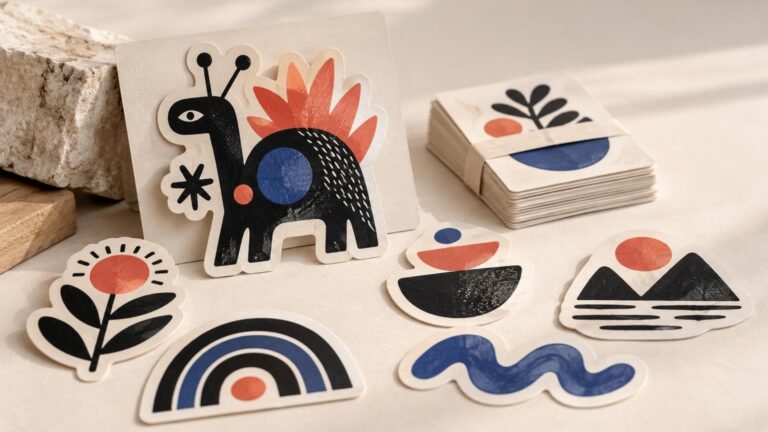
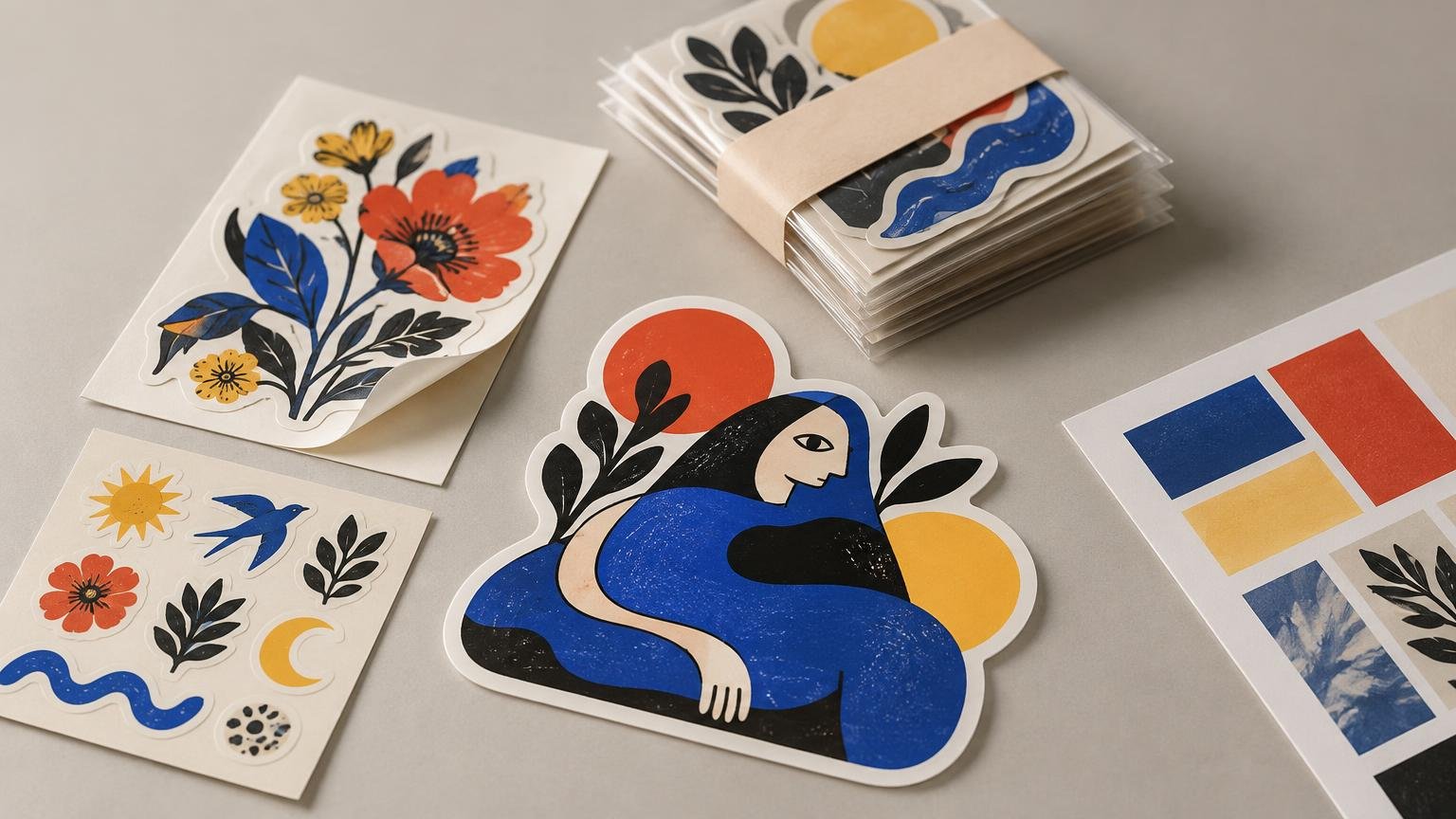
YouStickers offers custom vinyl stickers in custom sizes and shapes, with free online proofs and no stated minimum quantity. Its listed formats include standard vinyl, holographic, clear, kiss-cut, sticker sheets, bumper stickers, packs, chrome, and rolls. That range covers the most common artist-merch jobs without forcing every design into the same white-bordered die-cut format.
The ordering workflow is also artist-friendly on paper: upload the artwork, receive a digital proof, request revisions if necessary, and approve it before production. YouStickers says it accepts PNG, JPG, PDF, AI, and SVG files and can create a cut line when one has not been supplied. Review the current YouStickers formats and ordering options
That does not make every format equally suitable for every illustration. A specialty effect can energize a simple graphic but overwhelm artwork that already depends on texture, tiny marks, or subtle color relationships. Start with the visual job, then pick the material and finish—not the other way around.
Choose the sticker format around the artwork
Die-cut stickers for a strong silhouette
An individual die-cut sticker works best when the outer contour is part of the design. Character art, bold symbols, mascots, hand lettering, and compact emblems are natural candidates. Zoom out until the design is roughly the size it will be in a customer’s hand. If the silhouette still reads before the internal detail does, the shape is probably doing useful work.
Avoid tracing every hair, thorn, drip, or decorative notch with the cut line. A slightly simplified contour often looks more intentional and is less visually nervous at sticker scale.
Kiss cuts for delicate or irregular artwork
A kiss-cut sticker leaves the design on a larger backing area. It is helpful when a true die cut would create fragile projections or when the backing card can carry a signature, title, edition note, or small piece of supporting artwork. The backing can also make small stickers easier to handle at an art market.
Sticker sheets for sets and visual storytelling
Sheets make sense when several small images belong together: expressions from one character, icons from an illustrated world, miniature objects, or a coordinated set of decorative marks. Give the sheet a visual hierarchy. One larger anchor design surrounded by smaller pieces usually feels more composed than twelve unrelated objects competing at equal volume.
Packs for a more substantial merch item
A pack should feel curated rather than like leftover inventory in an envelope. Repeat one or two elements—palette, line treatment, border language, character family, or theme—while varying scale and composition. Our guide to turning artwork into a small-run vinyl sticker pack covers that creative process in more depth. Collectors also tend to notice whether a pack has a coherent point of view, not just whether it contains more pieces.
Matte or gloss: let the image decide
YouStickers describes matte as the lower-glare option and gloss as the shinier finish with more visual pop. That distinction is more useful than treating one finish as universally premium.
- Choose matte when the artwork depends on soft color, dense black areas, hand-drawn texture, or easy viewing under bright convention lights.
- Choose gloss when saturated color, hard-edged vector work, candy-like highlights, or a polished graphic surface supports the design.
- Use a specialty surface only when it contributes to the image. Holographic material can become part of a moon, visor, aura, water surface, or negative-space effect; across a detailed painting, it may simply become visual static.
- Keep a pack consistent unless the finish change has a clear purpose. Randomly mixing surfaces can make a set feel assembled rather than designed.
Finish can change perceived contrast and how readily surface detail is seen under direct light. If the distinction is central to the artwork, a small sample order is more informative than trying to judge the entire effect from a bright screen.
Treat the proof as a composition check, not a color promise
A digital proof is the last quiet moment before a minor problem becomes a stack of minor problems. Check the physical dimensions, orientation, spelling, cut-line position, border width, and whether important details sit too close to the edge. View the proof both enlarged and at approximate finished size.
YouStickers explains that its process printing uses CMYK. Artwork created in RGB can shift during conversion, and some Pantone colors fall outside the reproducible CMYK gamut. The company also says its digital proof can help confirm layout, size, and cut details but does not guarantee the final printed color. It recommends considering samples when color is critical. Read the printer’s current color-matching guidance
- Check the stated finished width and height rather than judging size from the preview alone.
- Inspect where the cut line passes around narrow limbs, lettering, spikes, and transparent areas.
- Reduce the proof to its expected physical size and look for disappearing facial features, clogged linework, and unreadable text.
- Ask whether a white base or visible material effect changes transparent and specialty designs.
- Order a sample or small initial quantity when a brand color, skin tone, gradient, or subtle shadow must be closely controlled.
- Save the approved proof and order details so a future reorder can be compared with the original.
A printer can reproduce a complex file cleanly and still produce a weak sticker if the original composition was never adapted for a small object. Strong contrast, a recognizable focal point, and breathing room around small text matter more than ornamental detail that is only visible at 300 percent zoom.
Professional service or an at-home setup?
The keyword “printer” can also mean desktop hardware. Home production offers immediacy and control, but it adds equipment, cutting, material testing, maintenance, and finishing to the artist’s workload. Outsourcing trades some of that control for a repeatable ordering process and more time to draw, pack orders, or prepare for an event.
| Decision factor | Professional printing service | At-home production |
|---|---|---|
| Best fit | Finished merch, launches, conventions, packs, and repeat orders | Prototypes, frequent tiny batches, experiments, and immediate changes |
| Artist workload | Upload, proof, approve, and wait for production and delivery | Print, cut, inspect, troubleshoot, and maintain supplies |
| Upfront commitment | Order cost and shipping rather than equipment ownership | Printer, cutter if needed, consumables, and workspace |
| Creative control | Broad format choices, but changes stop after proof approval | Direct control over each run and rapid iteration |
| Timing risk | Proof revisions, production, and carrier transit | Equipment trouble, material shortages, and hands-on production time |
| Consistency | Service handles the production workflow | Depends on calibration, materials, cutting, and operator process |
Outsourcing is usually the cleaner choice once stickers become inventory rather than occasional experiments. Home production becomes more compelling when the ability to change one color tonight is worth more than avoiding the labor tomorrow.
Plan backward from the event, not from the order date
A convention deadline needs room for proofing, revision, production, carrier transit, inspection, and a remedy if something arrives incorrect. YouStickers publishes a processing period before carrier transit, but service levels and shipping methods can change. Confirm the current estimate on the shipping policy and during checkout rather than treating an old timetable as a guarantee. Check the current shipping policy before scheduling an order
Build in more buffer when the design uses an unfamiliar finish, an intricate contour, or color that has never been physically sampled. Rush ordering cannot rescue artwork that needs two rounds of proof corrections. For a fixed event, approve the simplest confirmed version first; experimental variants can follow after the essential stock is secure.
Check the total order, not just the headline price
Before approving a quote, compare the same size, quantity, shape, material, finish, and shipping destination. A low displayed unit price can be irrelevant if it applies to a different quantity or excludes the option your art needs. Check the delivered total and calculate how many stickers must sell before the run pays for itself.
If you want a second quote, compare the same specification through another custom sticker printing service rather than comparing unlike sizes or finishes. The point is not to collect endless browser tabs; it is to find out whether the price difference is meaningful after proofing, options, shipping, and the value of your own time are considered.
Also read the issue-reporting policy before ordering. YouStickers states that production, fulfillment, or shipping mistakes may qualify for a reprint, replacement, or refund. Its published materials ask customers to report quality problems within 14 days of delivery and provide order details and photos; custom items generally cannot be returned simply because the buyer changed their mind. Verify the current wording when placing the order. Review the current returns policy
The practical verdict
YouStickers is our strong professional sticker-printing pick for artists who want polished custom vinyl merch, useful format choices, proofing, and the flexibility of no stated minimum. The recommendation is strongest for small launches, convention stock, online-shop extras, sticker sheets, and curated packs where outsourcing removes production work without removing the artist’s approval step.
The service is not automatically right for every project. Color-critical work deserves a physical sample, urgent events require scheduling buffer, and artists who constantly produce one-off experiments may prefer an at-home workflow. Start with one representative design, inspect the proof at actual size, and place a restrained first order. The best result is not merely a clean print—it is a sticker that still looks unmistakably like your work after the canvas has shrunk to a few inches.